




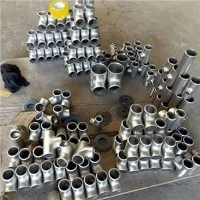
Carbon Steel ANSI SCH80 Pipe Fittings
These heavy-wall butt-weld fittings are manufactured to ASME B16.9 standards, with a schedule 80 wall thickness that's significantly thicker than standard schedule 40. These reinforced joints connect, branch, or change direction in high-pressure piping systems across oil and gas, chemical processing, power generation, and building hardware applications—providing extra strength where pipelines face the most stress. Made from ASTM A234 WPB carbon steel, they're welded directly to pipe ends for leak-proof, permanent joints, with smooth internal bores that minimize turbulence and pressure drop.
What These Fittings Are and Why They Matter
Most people don't think about pipe fittings until something goes wrong. A leak, a pressure drop, a weld that fails during startup-that's when these components get attention. Which is unfortunate, because the right fitting from the start prevents most of those problems.
These are heavy-wall butt-weld fittings built to ASME B16.9. The "SCH80" part means the wall is thicker than standard schedule 40. That's not a minor difference. For a 6-inch fitting, SCH80 wall thickness is 0.432 inches compared to 0.280 inches for SCH40. That extra material isn't there by accident-it's there because someone calculated that the system needs more strength at that joint. The fitting connects pipes, changes direction, or branches off to another line. But more importantly, it does those things without becoming the weak point in your system.
I've seen too many projects where the pipe itself is over-specified but the fittings are treated as an afterthought. That's backwards.

The joint is where stress concentrates, where pressure changes, where vibration transfers. That's why SCH80 exists-to handle those conditions.
Materials and Design: What's Actually Going On Here
ASTM A234 WPB is the standard material for these fittings. That's not marketing language; it's just what the industry settled on because it works. WPB stands for "wrought carbon steel, grade B." The chemistry is controlled-carbon, manganese, phosphorus, sulfur, silicon-to ensure consistent weldability and mechanical properties. Tensile strength runs around 70,000 psi, yield strength around 36,000 psi. Those numbers matter because they tell you how much pressure the fitting can handle before it deforms.
If your system runs above 1000°F, WPB isn't the right choice. We'd switch to WP5 or WP9, which have different alloying elements for high-temperature stability. If you're dealing with corrosive media, stainless steel (F304 or F316) is the better path. The material selection isn't about what's "best"-it's about what fits your specific operating conditions.
There's a reason butt-weld fittings are standard in high-pressure systems. The weld creates a continuous joint-no threads to leak, no socket to crack. The fitting and the pipe become a single piece of steel. The internal bore is smooth, which reduces turbulence. In fluid systems, turbulence means pressure drop and erosion. In gas systems, it means noise and flow restriction.
We machine the bevel ends to match ASME B16.9 tolerances. That's the detail that determines whether the welder can get a full-penetration weld on the first pass. If the bevel is off by a few degrees, the weld quality suffers. That's not speculation-I've seen x-rays of welds on fittings with poor bevel geometry. The defects are obvious.
|
Parameter |
Specification |
|
Standards |
ASME B16.9, MSS SP-43 |
|
Size Range |
1/2" – 48" (DN15 – DN1200) |
|
Schedule |
SCH80 (heavy wall) |
|
Material |
Carbon Steel ASTM A234 WPB |
|
Main Types |
Elbows, Tees, Reducers, Caps, Crosses |
|
Certifications |
ISO 9001, CE, PED |
ASME B16.9 covers dimensions, wall thickness, and tolerances for wrought steel butt-weld fittings. It's the baseline. MSS SP-43 is for lighter-wall fittings, but we hold SCH80 to B16.9 tolerances because the tighter dimensions actually matter when you're welding heavy wall.
The size range-1/2" to 48"-covers what most industrial systems need. Below 1/2", you're usually in instrument tubing territory. Above 48", the fittings become custom orders with longer lead times. We can do both, but the tooling and production schedule differ.
SCH80 is the main thickness we stock. It's heavy enough for most high-pressure applications but still weldable with standard procedures. The alternative schedules (SCH40, SCH60, SCH100, SCH120, SCH160, XXS) are available, but they're not usually stocked-they're made to order.
Surface treatment isn't complicated, but it matters. Here's what we offer:
|
Finish Type |
What It Does |
Best For |
|
Black Painting |
Standard anti-rust coating |
Indoor piping, short-term storage |
|
Varnish |
Clear protective layer |
When you need to see the steel surface for inspection |
|
Anti-rust Oil |
Light coating |
Short-term protection during transit |
|
Galvanized |
Zinc coating |
Outdoor or marine environments |
|
3PE Coating |
Three-layer polyethylene |
Buried pipelines |
I usually recommend black painting unless there's a specific reason to choose something else. It's cost-effective and provides enough protection for the installation phase. Galvanizing adds about 25-30% to the cost and doesn't add value if the fitting is going indoors. 3PE is overkill unless the fitting is buried underground.
Elbows : 45°, 90°, 180° - long radius (LR) is standard, short radius (SR) is available but less common
Tees : Equal tees for same-size branches, reducing tees for smaller branches
Reducers : Concentric (centered) and eccentric (offset) for transitioning between pipe sizes
Caps : For sealing pipe ends
Crosses : Four-way connections, used mainly in fire protection and manifold systems
The Production Sequence
Here's the process we follow:
Raw material receiving
Certified A234 WPB from approved mills. Each heat comes with melt reports showing chemical composition and mechanical properties.
01
Cutting and heating
The steel is cut to blank size and heated to forging temperature. Uniform heating is essential. If the temperature varies across the piece, the grain structure will be inconsistent.
02
Forging
The heated blanks go through the hydraulic press or the ring rolling machine. For elbows and tees, we use forming dies. This aligns the grain flow with the shape of the fitting, which improves strength.
03
Heat treatment
Normalizing or annealing relieves internal stresses and achieves the required hardness. Without this step, the fitting could be brittle or have residual stresses that cause distortion during welding.
04
Machining
Lathes and drillers bring the fitting to final dimensions. This includes facing the ends, beveling for welding, and boring the bore to match pipe ID tolerances.
05
Inspection
Dimensional checks, hardness testing, pressure testing. We inspect at three points: raw material, in-process, and final. Records are kept for seven years.
06
Coating
Final surface treatment for corrosion protection.
07

Application Range
I've seen these fittings used in:
Oil and gas transmission lines - high pressure, large diameter, critical reliability
Chemical plants - where material compatibility and leak-tightness are mandatory
Power generation - steam systems with temperature cycling
Building hardware and HVAC - heavy-duty commercial systems
Marine and shipbuilding - where saltwater corrosion is a factor
Each application has different requirements. In oil and gas, the focus is on pressure rating. In chemical plants, it's material compatibility. In power generation, it's thermal cycling. We've supplied across all of these, and the specification changes accordingly.
Who We Are
We're CANGZHOU HANGXIN FLANGE CO., LIMITED, established in 1993. That's over 30 years in this industry. We're not traders-we're the actual production facility.
The factory is in Mengcun County, Hebei. This area is recognized as the hometown of elbows and pipe fittings in China. It's not a marketing label-there are nearly 1,800 pipe equipment manufacturers here, and the region accounts for about 30% of the national output. Being located here means we have direct access to raw materials, specialized labor, and supporting industries that don't exist elsewhere.
Logistically, we're 120 kilometers from Xingang Port in Tianjin and 260 kilometers from Beijing Capital International Airport. That proximity reduces freight costs and transit times, which matters when you're shipping containers internationally.
Capabilities
The facility covers about 18,000 square meters with fixed assets around 50 million yuan. Equipment includes:
3500T hydraulic press
2500D CNC ring rolling machine
7 forging hammers
7 large band saws
Lathes and drillers for finishing
Annual output is approximately 13,000 tons. That's not an arbitrary number-it's based on actual production capacity. We can handle large orders, but we're also equipped for smaller, custom runs.
Certifications: ISO 9001, 3A, CE. These are frameworks we operate within, not just wall decorations.
A Specific Delivery
Last year, a French contractor ordered 500 pieces of SCH80 elbows in 6" and 8" sizes for a chemical plant expansion. The deadline was 25 days including ocean freight to Marseille. We completed production in 18 days. The fittings passed inspection, the shipment arrived on time, and we've received follow-on orders quarterly since.
I mention this not because it's exceptional-it's the kind of outcome we aim for consistently. The client knew what they needed, we executed, and they've continued ordering. That's the relationship pattern we aim for.

Whether you need a standard Carbon Steel ANSI SCH80 Pipe Fitting or something with custom dimensions, material variations, or specialized coatings, we can handle it. We're a carbon steel butt-weld fitting supplier from Hebei, China, with a production history that predates most of our competitors.
Contact Sandy for a quote or to discuss your project:
Mobile / WhatsApp / WeChat: 0086-15127785550
Skype: sandy198607
Email: sandy@yongxingflange.com
Address: Dingzhuangzi Industrial Zone, Mengcun, Hebei, China.
Specify your requirements clearly, and we'll tell you if we can meet them-and if not, we'll tell you that too.
Frequently Asked Questions
Expert Answers on Carbon Steel ANSI SCH80 Pipe Fittings
What exactly are Carbon Steel ANSI SCH80 Pipe Fittings?
+
-
They're butt-weld fittings made from ASTM A234 WPB carbon steel, manufactured to ASME B16.9 standards, with schedule 80 wall thickness. They connect, branch, or redirect pipes in high-pressure systems. As a manufacturer based in Mengcun, Hebei-China's recognized pipe fitting production center-we follow these standards consistently.
How do these function in a piping system?
+
-
They're butt-welded directly to the pipe ends. The weld creates a permanent joint that matches the pipe's strength. The SCH80 wall thickness adds reinforcement at the connection point, which is where stress tends to concentrate. Proper welding is essential-the fitting's design assumes full-penetration welds.
How do SCH80 fittings compare to SCH40?
+
-
The main difference is wall thickness. For a given pipe size, SCH80 has thicker walls than SCH40, which translates to higher pressure ratings and greater resistance to mechanical loads. If your system operates at higher pressures or you need extra corrosion allowance, SCH80 is the logical choice. If weight and material cost are the primary constraints, SCH40 may be sufficient. We supply both from our Mengcun facility.
What alternative materials are available?
+
-
We can supply WPC for higher-temperature applications, WP5/WP9/WP11 for alloy requirements, and stainless steel grades F304, F316, and others for corrosive environments. The choice depends on operating temperature, fluid composition, and pressure.
Where are these fittings commonly installed?
+
-
Oil and gas pipelines, chemical processing plants, power generation facilities, building hardware systems, marine installations, and any high-pressure industrial piping that requires durable, leak-tight joints. Our location near Xingang Port allows us to ship these efficiently to global destinations.

Hot Tags: carbon steel ansi sch80 pipe fittings, China carbon steel ansi sch80 pipe fittings manufacturers, suppliers, factory, Carbon Steel Pipe Fittings


Send Inquiry
