

What is the modulus of rigidity of Npt Threaded Flanges?
Jul 04, 2025
Hey there! As a supplier of Npt Threaded Flanges, I often get asked about all sorts of technical details. One question that pops up quite a bit is, "What is the modulus of rigidity of Npt Threaded Flanges?" So, let's dive right into it and break it down in a way that's easy to understand.
First off, let's quickly go over what Npt Threaded Flanges are. NPT stands for National Pipe Tapered. These flanges are used in piping systems to connect pipes, valves, and other equipment. They have tapered threads that create a tight seal when they're screwed together. This makes them super useful in a bunch of industries, like oil and gas, chemical processing, and water treatment.
Now, let's talk about the modulus of rigidity. The modulus of rigidity, also known as the shear modulus, is a measure of how much a material can resist shearing forces. In simpler terms, it tells us how stiff a material is when it's being twisted or bent sideways. When we're dealing with Npt Threaded Flanges, understanding the modulus of rigidity is crucial because it helps us figure out how well the flanges will hold up under different loads and stresses.
The modulus of rigidity is denoted by the letter "G" and is measured in units of pressure, like pascals (Pa) or pounds per square inch (psi). For Npt Threaded Flanges, the value of G can vary depending on a few factors. One of the main factors is the material the flange is made from.
Most Npt Threaded Flanges are made from metals like carbon steel, stainless steel, or alloy steel. Each of these materials has its own unique properties, including different values of the modulus of rigidity. For example, carbon steel is a popular choice for Npt Threaded Flanges because it's strong, durable, and relatively inexpensive. The modulus of rigidity for carbon steel typically ranges from about 75 to 80 gigapascals (GPa), or around 10,900,000 to 11,600,000 psi.
Stainless steel, on the other hand, is known for its corrosion resistance. It's often used in applications where the flanges will be exposed to harsh environments. The modulus of rigidity for stainless steel is usually a bit lower than that of carbon steel, ranging from about 70 to 75 GPa, or around 10,100,000 to 10,900,000 psi.
Alloy steel is another option for Npt Threaded Flanges. It's made by adding other elements to steel to improve its strength, hardness, and other properties. The modulus of rigidity for alloy steel can vary widely depending on the specific alloy composition, but it's generally in the same ballpark as carbon steel.
Another factor that can affect the modulus of rigidity of Npt Threaded Flanges is the manufacturing process. Flanges that are forged tend to have a higher modulus of rigidity than those that are cast. This is because forging compresses the metal, making it denser and more uniform. As a result, forged flanges are often stronger and more resistant to deformation.
So, why does all this matter? Well, when you're choosing Npt Threaded Flanges for your project, you need to make sure they can handle the loads and stresses they'll be subjected to. If the modulus of rigidity is too low, the flanges may deform or break under pressure, which can lead to leaks and other problems. On the other hand, if the modulus of rigidity is too high, the flanges may be too stiff and difficult to install or adjust.
As a supplier, I always make sure to provide my customers with detailed information about the materials and properties of my Npt Threaded Flanges. That way, they can make an informed decision and choose the right flanges for their needs.
Now, if you're in the market for other types of threaded flanges, we also offer BSP Threaded Flange, Carbon Steel Threaded Flange, and DIN Threaded Flanges. These flanges have their own unique features and applications, so be sure to check them out if you think they might be a good fit for your project.
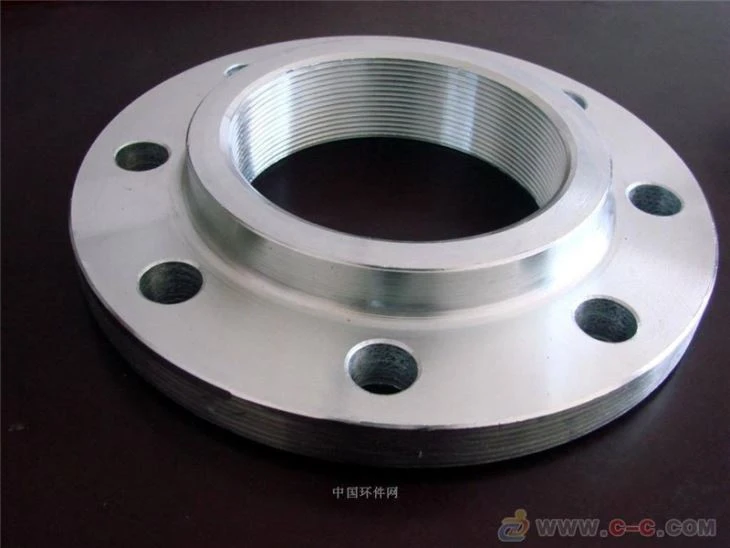

In conclusion, the modulus of rigidity is an important property to consider when choosing Npt Threaded Flanges. By understanding how it works and what factors can affect it, you can make a more informed decision and ensure that your flanges will perform well in your application.
If you have any questions or if you're interested in purchasing Npt Threaded Flanges, feel free to reach out. I'm always happy to help and can provide you with a quote based on your specific requirements. Let's work together to find the perfect flanges for your project!
References
- "Materials Science and Engineering: An Introduction" by William D. Callister Jr. and David G. Rethwisch
- "Mechanical Engineering Design" by Joseph E. Shigley and Charles R. Mischke